This collection represents an explorative map of danah boyd’s contributions to the field of digital rhetoric. From the early days of MySpace to the complex ethical landscapes of Big Data, these works investigate how humans negotiate identity within the constraints of digital architecture.
Important Books Written or Co-Written by danah boyd:
It’s Complicated: The Social Lives of Networked Teens
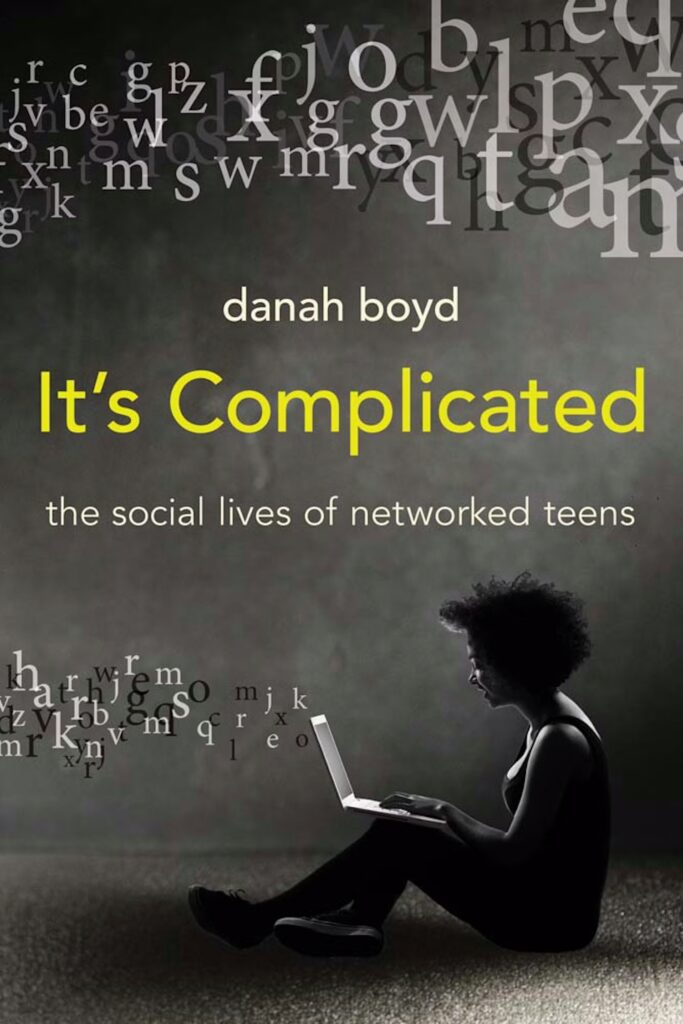
Perhaps boyd’s most famous publication, this book debunks the “digital native” myth. Based on a decade of ethnographic research, it explores how teenagers use social media to find a “place of their own” in an increasingly adult-regulated world.
In this text, boyd shifts the rhetorical focus from “the screen” to the environment. She argues that digital spaces are not “virtual realities” separate from our lives, but networked publics where teens perform identity while navigating the “Context Collapse” created by overlapping social circles (parents, peers, and teachers all watching the same post).
Participatory Culture in a Networked Era: A Conversation on Youth, Learning, Commerce, and Politics
In this collaborative work, boyd joins scholars Henry Jenkins and Mizuko Ito to engage in a cross-disciplinary dialogue regarding the shifting landscape of digital engagement. Unlike a traditional monograph, this book is structured as a “conversation” that critiques the evolution of participatory culture—moving beyond early internet optimism to examine how commercial interests, civic life, and social inequality intersect. The purpose of this text is to analyze how “participation” is not a universal experience, but one that is deeply shaped by the platforms we use and the socioeconomic gaps that persist in a networked society.
Hanging Out, Messing Around, and Geeking Out: Kids Living and Learning With New Media
This landmark ethnographic study introduces the “HOMAGO” framework, mapping three distinct genres of youth participation: Hanging Out (socializing), Messing Around (tinkering), and Geeking Out (deep interest). boyd and her colleagues argue that these informal digital practices are not distractions, but are essential for developing the literacies required in a networked world.
By reframing “play” as a site of functional and critical literacy, this work challenges traditional educational hierarchies. It proves that the rhetoric of “messing around” is actually the foundation for technical mastery and social agency. This entry illustrates how digital infrastructure creates unique spaces for youth to move from passive consumers to active, rhetorically-aware creators.
Important Papers by danah boyd:
Techno-legal Solutionism: Regulating Children’s Online Safety in the United States
In this critical analysis, boyd critiques “techno-legal solutionism”—the flawed belief that complex social problems can be “solved” through a combination of restrictive laws and technical barriers (like age verification). She examines how United States regulations, such as COPPA, often prioritize corporate legal compliance over the actual safety and wellbeing of minors, frequently resulting in unintended consequences that disenfranchise the very youth they aim to protect.
Situating Methods in the Magic of Big Data and Artificial Intelligence
In this influential work, boyd and M.C. Elish challenge the cultural tendency to view Big Data and Artificial Intelligence as objective, “magical” forces. They argue that these technologies are deeply situated in human decisions, social contexts, and historical biases rather than being neutral mirrors of reality. The purpose of this piece is to demystify the “black box” of AI, urging researchers to move past the hype and acknowledge the ethical and methodological responsibilities inherent in data-driven systems.
boyd exposes the rhetoric of “objectivity” that surrounds AI, revealing it as a strategic narrative used to mask human error and systemic bias. By insisting that data must be “situated” within its social origin, she proves that algorithms are not just mathematical formulas—they are rhetorical arguments made by those in power. This text is essential for understanding how the “magic” of technology can serve as a rhetorical shield for social inequality.
Data Voids: Where Missing Data Can Easily Be Exploited
In this influential report (co-authored with Michael Golebiewski), boyd identifies “data voids”—specific search queries for which little or no high-quality content exists. These voids create a strategic vacuum where malicious actors can manipulate search engine results to promote disinformation, conspiracy theories, or fringe ideologies. The purpose of this work is to expose a critical vulnerability in our information ecosystems: the fact that search engines are most easily weaponized not when there is a surplus of information, but when there is a calculated absence of it.
The Structuring Work of Algorithms
In this research, boyd (often in collaboration with scholars at the Data & Society Research Institute) moves beyond the user interface to examine the “logic” of the algorithm. She argues that algorithms are not neutral mathematical formulas; they are “structuring” forces that make value judgments, categorize people, and distribute resources.
This entry represents the pinnacle of critical and rhetorical literacy. boyd argues that algorithms perform “rhetorical work” by deciding what is relevant, what is true, and what is visible. By framing algorithms as “structuring” agents, she reveals that the “rhetor” in the digital age isn’t always a human—it’s the encoded logic that governs our digital networked publics. This is a crucial text for understanding how power is automated through digital design.
White Flight in Networked Publics? How Class and Race Shaped American Teen Engagement with MySpace and Facebook
A critical look at the migration of users from MySpace to Facebook, analyzing how social and racial divisions in the physical world were replicated in digital spaces.
This work highlights boyd’s critical literacy. She challenges the idea that the internet is a “neutral” space. By analyzing the rhetoric of “cleanliness” and “safety” used to justify the move to Facebook, she exposes how digital rhetoric can be used to reinforce existing social hierarchies and “digital segregation.”
Social Network Sites as Networked Publics: Affordances, Dynamics, and Implications
This foundational article provides the vocabulary for understanding how social media changes the “rhetorical situation.” It introduces the four affordances that define digital communication.
In this piece, boyd identifies the “hidden” architecture of the internet: Persistence, Visibility, Spreadability, and Searchability. She proves that digital rhetoric is unique because the “audience” is no longer just who is in the room — it is anyone who can search for or stumble upon the record of the speech act.